Following up a bit on my Antoine Lavoisier I thought about what we know about the particles in a cell. Originally people believed that if you took a log and cut it in half you would still have even if you continued to cut the log infinitely. We now know that this is not correct but after you cut a board long enough you will reach a point where you will see the basic building block of life the cell.
A cell is not even the smallest part that you get a cell is made up of electrons, protons, and neutrons. Quarks then are what make up electrons, protons, and neutrons. Which is made up of even smaller particles.
These different particles could not be found until there were advances in technology. Through technology new theories are able to be verified. Currently there is a theory about a particle being called the Higgs Bison particle. This theory was developed in 1964 but because of technological shortcoming his theory couldn't be proven at that time. Today with the aid of particle accelerators scientist are thinking that they may be able to prove the existence of the Higgs particle in the coming months.
Here is a quote from Time Magizine,
"Working from Higgs' theory, scientists postulate that initially weightless particles move through a ubiquitous quantum field, known as a Higgs field, like a pearl necklace through a jar of honey. Some particles, such as photons — weightless carriers of light — can cut through the sticky Higgs field without picking up mass. Others get bogged down and become heavy; that is the process that creates tangible matter."
Read more: http://www.time.com/time/health/article/0,8599,1729139,00.html#ixzz1qCAT43To
Through technological advances much of the scientific gap can be closed.
Sunday, March 25, 2012

Phobia:
a persistent, irrational fear of a specific object, activity, orsituation that leads to a compelling desire to avoid it.
A phobia is defined as an irrational, intense fear of an object or situation that poses little or no actual danger
I took my little sister to the doctor this week and she had to get her ears checked out. She is exceptionally afraid of having things near or in her ears. She doesn't fall under the scientific definition of a phobia, however she would under the typical view of society. Phobia is a term often overused to define regular fears. People use the word to describe regular fears like the fear of spiders or bugs.

a persistent, irrational fear of a specific object, activity, orsituation that leads to a compelling desire to avoid it.
A phobia is defined as an irrational, intense fear of an object or situation that poses little or no actual danger
I took my little sister to the doctor this week and she had to get her ears checked out. She is exceptionally afraid of having things near or in her ears. She doesn't fall under the scientific definition of a phobia, however she would under the typical view of society. Phobia is a term often overused to define regular fears. People use the word to describe regular fears like the fear of spiders or bugs.
Phobias are only considered such if they get in the way of normal functioning and everyday life. However, fear in the traditional sense is a normal part of life.
Thursday, March 22, 2012
Annotated Bibliography
Smithsonian.com, Copernicus Unearthed, Smithsonian Magazine, 2006 Here they address a lot about how Copernicus was the first person to be able demonstrate that the earth orbited the sun and not the other way around. It also shows that even when you are the person who comes up with a great new concept you will not always be accepted for it.[Internet]
Ludwig Heinrich Heydenrich, Leonardo da Vinci, Encyclopedia Britannica, 2012 This covers the whole life and the scientific works of da Vinci. He was a man who didn't have formal training is science but was able to come up with detailed scientific research because he was one of the first people to document and use the scientific method.[Internet]
Peter Saundry, Lavoisier Antoine-Laurent, The Encyclopedia of Earth, 2010 Peter Saundry talks about the life of Lavoisier and how his work was influential in changing how the world views science. Didn't work within the current scientific system because he didn't go to the typical schooling of scientists at his time period. [Internet]
Nielsen, Michael. Reinventing Discovery, Princeton University Press, 2011 Michael talks about how science has had the ability to now have people work on something and have rapid contact by other people to help in the development and vetting of new ideas. He uses examples of things like how the human genetic map was compiled by many different people.[Professor Burton]
Beretta, Marco. Lavoisier in Perspective, Wolf & Sohn, 2005 Lavoisier in Perspective speaks about how Lavoisier was a man who was able to introduce revolutionary changes in chemistry. Lavoisier was able to help make many changes in the science world through his ability to look at work of others and connect their work together to become something coherent that actually made sense.[Library]
Guerlac, Henry. Lavoisier-The Crucial Year. Cornell University Press. 1961 Henry makes note of how we don't really know all that much about the time when Lavoisier switched from his early research to his research on combustion. This switch of his is what let him to understanding that matter is conserved in a reaction and has the same mass at the end of a reaction.[Library]
Sunday, March 18, 2012
Center of the Universe
For the longest time people believed that the earth had to be the center of the Universe and that all the stars, the moon, and the sun revolved around the earth. This is what I call a self centered problem, first the world is flat and then the center of the universe, seems like we have to feel like we are important.
 There is a man who's name was Copernicus, he is the man who helped us move away from this problem of not understanding where the earth is placed in reference to the rest of the Galaxy. Copernicus had studied the work of astronomers in the past and from these things he posed the theory that the earth was not what everything revolved around. He believed that the sun was the center and that the earth and all of the other planets revolved around the sun.
It turns out he was correct. Copernicus was not a man though that wanted to shake up the system if he was not absolutely sure he was correct. He could have published his finding early on in his career but he didn't want to be proven wrong. Copernicus was a scientist who went more of the traditional root that we think of for science today he went to university and studied about arithmetic, geometry, geometric optics, cosmography, and theoretical and computational astronomy.
Copernicus's theory was called Heliocentrism. According to Heliocentrism the earth moves; that the sun occupies the lowest, and thus the central, place in the universe. Through study Copernicus was able to learn from past experts in his field and expound and add to the theories that were being developed.
It turns out he was correct. Copernicus was not a man though that wanted to shake up the system if he was not absolutely sure he was correct. He could have published his finding early on in his career but he didn't want to be proven wrong. Copernicus was a scientist who went more of the traditional root that we think of for science today he went to university and studied about arithmetic, geometry, geometric optics, cosmography, and theoretical and computational astronomy.
Copernicus's theory was called Heliocentrism. According to Heliocentrism the earth moves; that the sun occupies the lowest, and thus the central, place in the universe. Through study Copernicus was able to learn from past experts in his field and expound and add to the theories that were being developed.
Sunday, March 11, 2012
Antoine Lavoisier
Have you ever heard of this man? When you think of chemistry he is probably not the first thing to come to mind but Antoine is one of the people that made real change happen is the field of chemistry.

Antoine was a man who didn't have any formal training is science. In fact he went to school to become a lawyer. This was his parents wish but after he was done with his schooling he never did practice law. Instead Antoine devoted his efforts to science.
What was his greatest discovery and theory, the conservation of mass is basically what his theory was. Antoine believed that if you contained a reaction all parts of the chemical reaction and weighed the inputs and the out puts that the products of the reaction would weigh the same. While Antoine wasn't the person who first came up with this idea he was the man who figured out how to make it so that other people could understand the process and information and was able to show that discoveries were true thank to doing studies over again. This show that to create real change you do not necessarily need to come up with amazing new ideas but you do have to spend the time to check the findings of others and then explain the concepts in greater detail to truly make a difference in the world.
Da Vinci science and art.
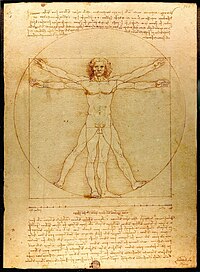
The Vitruvian Man one of Leonardo Da Vinci's most famous works just shows how through art science can be advanced. Leonardo didn't have formal training as a scientist, but contrary to the scientists of his time, Leonardo was one of the first scientists to use the basic scientific method that we see today. He would observe some action and question how is was being accomplished and would then spend time and observe the action in process and he managed to develop many sound theories because of this. For the Vitruvian Man Leonardo spent hour on hours observing hoe the human body moved and was able to draw an accurate portrait of how the human muscles work.
One thing Leonardo did that really connected his work to the future was he kept diaries and in these all of his observations and work are contained.

The most difficult part for understanding Leonardo's work is that he wrote his journals in mirror handwriting. What this means is that to read his journals you need to be able to either read backwards or get a mirror and read his writing by looking at it through a mirror. Da Vinci's work has really captured people's attention in the modern day because many of his invention designs are actually plausible. He didn't include everything that would be needed for the machines to work but the designs are sound otherwise. This has let many people to make his inventions because we now that the technology and materials to make his inventions plausible. Just think Da Vinci was a scientist without formal training in science but through observing his surroundings he was able to come up with many amazing inventions.
Sunday, March 4, 2012
Comparing the Depression to the Recession
"The main causes of both crises lie in actions of the federal government. In the case of the Great Depression, the Federal Reserve, after keeping interest rates artificially low in the 1920s, raised interest rates in 1929 to halt the resulting boom. That helped choke off investment. Also, President Hoover signed into law the sky-high Smoot-Hawley Tariff, which stifled trade and damaged American exports throughout the 1930s. Finally, the President signed a large tax increase into law in 1932, which halted entrepreneurship.
The seeds of the Great Recession were planted when the government in the 1990s began pushing homeownership, even for uncreditworthy people, with a vengeance. Mortgage-backed securities built on dubious mortgage loans became “toxic” when the housing market took a downturn, and many American banks verged on collapse. The government’s urgent desire to bail out various banks and corporations created uncertainty and instability, and this may have widened the recession."
During the Great Depression the unemployment rate was extremely high up to 25 percent of all workers were out of work. While on the other hand during the Great Recession the unemployment rate got up to 10.1 percent. While this is extremely high it is nothing compared to the Great Depression.
Subscribe to:
Posts (Atom)